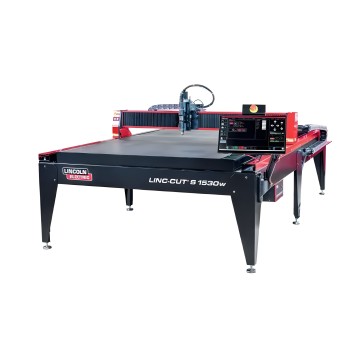
The plasma cutting table is a piece of equipment that combines a plasma cutter and a driven motion system (often CNC) to cut metal with precision. Essential for complex cuts and series production, the plasma table automates tracing and cutting. Discover our selection of cutting tables.
How a plasma table works
The CNC plasma table moves the cutting torch along a numerical program, in X and Y, above a flat surface on which the sheet metal rests. The plasma cutter cuts the metal while the CNC follows the programmed path. The result is fast, precise, and reproducible cutting, even on complex shapes.
What are the possibilities?
The CNC plasma cutting table enables straight, curved, circular, and complex cuts that are impossible or very time-consuming by hand. It is designed for manufacturing metal parts in series or to custom specifications: plates, brackets, signs, decorative elements, industrial parts. The table opens up creative and productive possibilities far beyond manual cutting.
Selection criteria
To choose a plasma table, assess the working surface (based on the size of your sheets), guidance precision, compatibility with your cutter (amperage, thickness capacity), and the control software. The rigidity of the frame and the quality of the guides determine cutting precision over time.
Extraction and safety
Plasma cutting on a table generates fumes and spatter. A quality plasma cutting table integrates or pairs with an extraction system or a water table that captures fumes and slag. Combined with good ventilation and appropriate personal protective equipment, this system ensures safe working conditions.
A productive investment
The plasma cutting table is a significant investment that pays for itself through productivity, precision, and reduced waste. For a workshop that regularly cuts sheet metal, it transforms the workflow: hours of manual tracing and cutting become minutes of programming and automatic execution.
Software and programming
The heart of a CNC plasma table is its control software. You import cutting files (often DXF or SVG), adjust parameters (speed, amperage), and start execution. Good software simplifies implementation and reduces errors. For beginners, intuitive software makes a real difference; for professionals, advanced features (nesting, offcut optimization) maximize productivity and reduce material waste.
Table maintenance
The plasma cutting table requires regular maintenance: cleaning of the grids or water tray, checking of guides and motors, replacement of plasma cutter consumables (nozzle, electrode). Regular maintenance ensures cutting precision and extends the service life of the entire unit. Slag and metal residues accumulate quickly: regular cleaning prevents them from obstructing movement or damaging the guides.
Table size and projects
The working surface of the plasma table determines the maximum size of parts that can be cut in a single pass. A compact table suits small parts and restricted workshops; a large table accommodates standard-format sheet metal and large-scale projects. Also consider the space needed around the table for loading sheets and removing cut parts.
From manual cutting to CNC
The CNC plasma cutting table transforms the workshop workflow. Manual plasma cutting is fast but limited to simple lines and the precision of the hand. The CNC plasma table automates everything: complex patterns, series cutting, perfect repeatability. It is a qualitative leap that opens up new creative and productive possibilities, quickly paying back the investment for a workshop that regularly cuts metal parts, both in series and to custom specifications.
Before investing, honestly assess the volume of cutting in your workshop: the CNC plasma table is fully justified for regular use, while manual plasma cutting remains relevant for occasional use.
Our advice
To automate and improve the precision of your cuts, the CNC plasma table is the solution. Choose it based on the working surface, precision, compatibility with your cutter, and the software. Plan for fume extraction. Browse our selection of plasma cutting tables.
Frequently asked questions
What is a plasma cutting table used for?
It combines a plasma cutter and a driven motion system (CNC) to cut metal with precision according to a numerical program. It enables straight, curved, and complex cuts, quickly and reproducibly, that are impossible or very time-consuming by hand.
What are the criteria for choosing a plasma table?
The working surface, guidance precision, compatibility with your cutter (amperage, thickness), the control software, and the rigidity of the frame. The quality of the guides determines cutting precision over time.
Is an extraction system needed for the plasma table?
Yes, cutting generates fumes and spatter. A quality table integrates or pairs with an extraction system or a water table that captures fumes and slag. This is essential for safe working conditions.
Is the plasma cutting table cost-effective?
For a workshop that regularly cuts sheet metal, yes: it pays for itself through productivity, precision, and reduced waste. Hours of manual tracing and cutting become minutes of programming and automatic execution.


 Germany
 Netherlands
 Croatia
 Denmark
 Finland
 Greece
 Ireland
 Portugal
 Sweden
 Norway
 Bulgaria
 Estonia
 Latvia
 Lithuania
 Poland
 Czech Republic
 Romania
 Slovakia
 Slovenia
 Hungary
 Spain
Spain



 2-year warranty