Spot Welding Machine - Bodywork Spot Welder - Spot Welding Machine | Best prices at EURO-WELDING

Active filters

Filter by

Brand

Brand

Usage

Usage

By choosing a welding machine on the EURO-WELDING website, you are guaranteed that it is designed by a French or European manufacturer complying with the EN 60974-1 manufacturing standard.

Compliance with this EN 60974-1 standard by the manufacturer guarantees that the equipment produced is intended for industrial and professional use, and that with regard to the rules relating to electromagnetic compatibility, this equipment is rated class A.
It is your responsibility to check the following points before any use
- That the electrical network used when operating this type of equipment is properly earthed
- That the electrical line to which you connect the welding machine is controlled by a fuse whose amperage is in line with that indicated on the nameplate of the machine or that indicated in the supplier's manual.
Depending on the model of machine that interests you, specifically its power in Amperes or its type of current (single-phase or three-phase), it is your responsibility to contact your electricity supplier to ensure that you have the appropriate subscription.
-Pacemaker wearers should consult a doctor before using this equipment. Exposure to electromagnetic fields during welding may have other effects on health that are not yet known.
As a general rule, as with any other tool, it is essential to read the user manual provided with the machine, including the safety instructions, before using this equipment.

Active filters

favorite_border favorite
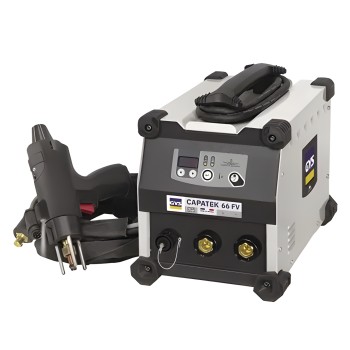
GYS CAPATEK 66 FV | Drawn-arc gun

Supplier stock

Gys

Reference: 081000

€1,971.31

1 615,83 € tax excl.

or 4 x 492,83 €

Free delivery

2-year warranty

The CAPATEK 66 FV is an industrial capacitor discharge stud welder with drawback, capable of welding studs from M3 to M8 in copper-coated steel, stainless steel, aluminum and brass onto thin sheet metal without marks or deformation. Its ergonomic and revolutionary gun with adjustable drawback and force ensures an ultra-fast welding rate. Its "FV" technology allows it to be used on all single-phase networks (85 to 265 V).

MAXIMUM PRODUCTIVITY

66 mF capacitor discharge.
Recharge time from 0 to 5 s.
Wide choice of studs, from M3 to M8.
Compatible stud length: 6 to 40 mm.

CONTACT GUN

Adjustable force from 25 to 100 N with cover to prevent accidental adjustments.
Independent tripod design with bayonet locking for better gun stability during welding and to facilitate mandrel installation
Trigger for easy control of the welding action.
LED lighting for the welding area. Unique on the market, several functions:
- Fast LED flash: error, machine under load.
- Slow LED flash: preset stud count reached.

INTUITIVE INTERFACE

Voltage adjustment from 50 V to 200 V.
Settings lock.
Stud counter with adjustable threshold (incremental or decremental).

INDUSTRIAL DESIGN

Protected against overvoltages up to 400 V (PROTEC 400)
Reinforced casing with anti-shock pads on all external faces
Easy welding polarity change via 35/50 bayonet connector
Delivered with two split earth clamps to prevent magnetic arc blow effects
Handle with integrated mains cable winder
Automatic standby mode
ON/OFF switch located at the rear of the machine
Active ventilation as needed

favorite_border favorite
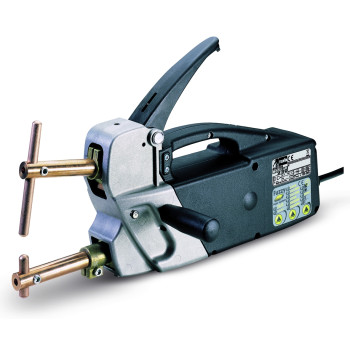
TELWIN - Modular 400 three-phase | Spot welder

In stock

Telwin

Reference: 823017

€1,091.90

895,00 € tax excl.

or 4 x 272,98 €

Free delivery

2-year warranty

This portable spot welding system is the ideal tool for assembling thin mild steel sheets such as metal furniture or vehicle restoration
Thanks to the selection of the thickness of the sheets to be assembled, the portaspot defines the optimal current and spot welding time. You can also manually adjust this spot welding time
It allows the assembly of sheets from 0.6 + 0.6 mm up to 2.0 + 2.0 mm
The spot mode is continuous or pulsed depending on the type of sheet
It features clamping force adjustment on the arm and has a handle made of thermal insulating material
Its power supply is three-phase 400 V and requires for its operation an electrical line controlled by a 16 A fuse
Supplied with the standard 120 mm arm
Welder weight 10.5 kg
The arms of this device have a diameter of 20 mm and the electrodes have a diameter of 12 mm
Supplied without power plug.

favorite_border favorite
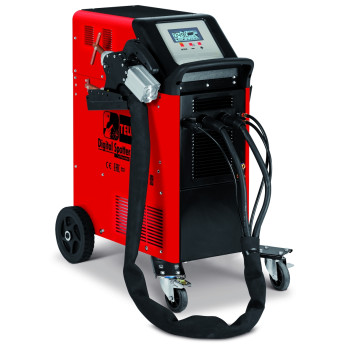
TELWIN - Digital Spotter 9000 | Spot Welder

Supplier stock

Telwin

Reference: 823195

€4,256.58

3 489,00 € tax excl.

Free delivery

2-year warranty

This spot welding system is the tool for assembling thin sheets of mild steel or stainless steel such as metal furniture or automotive restoration and repair
The multifunction digital display allows automatic regulation of the spot welding parameters depending on the tool selected and the sheet thickness
This unit enables individual and continuous welding of steel sheets, stainless steel, and galvanized sheets in pulsed mode
With the optional studder kit reference 802833, it enables spot welding of screws, washers, nails, rivets, washer spot welding and pulling, and intermittent spot welding
Automatic control of the mounted tool and voltage
It allows the assembly of sheets up to a thickness of 3.0 + 3.0 mm
The spot welding mode is continuous or pulsed depending on the type of sheet
It features an adjustable clamping force on the arm and a thermally insulating material handle
Single-phase 400 V power supply with a 32 A fuse socket
Supplied with a pneumatic clamp with air cooling and the standard 120 mm arm

favorite_border favorite
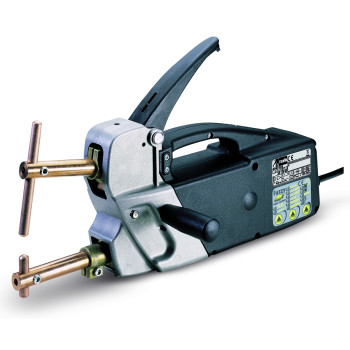
TELWIN - Modular 230V single-phase | Spot welder

In stock

Telwin

Reference: 823016

(31 reviews)

€1,011.59

829,17 € tax excl.

or 4 x 252,90 €

Free delivery

2-year warranty

This portable spot welding system is the ideal tool for assembling thin mild steel sheets such as metal furniture or vehicle restoration
Thanks to the selection of the thickness of the sheets to be assembled, the portaspot defines the optimal current and spotting time. You can also manually adjust this spotting time

It allows the assembly of sheets from 0.6 + 0.6 mm up to 2.0 + 2.0 mm
The spotting mode is continuous or pulsed depending on the type of sheets

It features a clamping force adjustment on the arm and a handle made of thermal insulating material
Its power supply is single-phase 230 V and requires for its operation an electrical line controlled by a 25A fuse
Supplied with the standard 120 mm arm
Welder weight: 10.5 kg
The arms of this unit have a diameter of 20 mm and the electrodes a diameter of 12 mm
Supplied without power plug

The spot welding machine joins two sheets by localized fusion, without filler metal or gas. Widely used in bodywork, the spot welder creates fast and clean weld spots between overlapping sheets. Discover our selection of spot welding machines for bodywork and sheet metal work.

The principle of spot welding

Spot welding relies on electrical resistance: two electrodes press the sheets against each other and pass a high current through them. The resistance at the contact point heats the metal to fusion, creating a weld spot. Spot welding requires neither gas nor filler metal, which distinguishes it from arc processes.

Why use a spot welder in bodywork?

The bodywork spot welder is the reference tool for joining thin sheets, particularly in automotive repair. It reproduces the original manufacturer weld spots, quickly and discreetly, without distorting or overheating the sheet as a poorly controlled arc process would. Bodywork spot welding ensures clean and compliant assemblies.

Clamp or arm: the configurations

Spot welding machines come in several configurations. The welding clamp, manual or pneumatic, presses the two sheets between its electrodes: ideal for areas accessible from both sides. Models with arms and interchangeable electrodes adapt to different bodywork geometries. The choice depends on access and the type of repair.

Choosing the right spot welding machine

To choose a spot welding machine, examine the power rating (which determines the weldable sheet thickness), the type of power supply, the ergonomics of the clamp, and the accessories (electrodes, arm). In bodywork, compatibility with thin sheets and modern steels is essential. Good electrode clamping is the key to a solid spot.

Spot welding or arc processes?

The choice depends on the assembly. The spot welding machine excels on thin overlapping sheets, in bodywork. For structures, greater thicknesses, or continuous beads, arc processes are used: MIG-MAG for productivity, MMA for versatility, or a professional automotive MIG machine for bodywork. Each process has its domain.

Safety and implementation

Spot welding generates high current and localized heat. Ensure good electrode contact, clean and well-prepared sheets, and wear appropriate protection: gloves and eye protection. Regular electrode maintenance (cleaning, reshaping) ensures consistent spots.

Preparing the sheets before spot welding

The success of a weld spot largely depends on preparation. The sheets must be clean, free of paint, rust, and filler at the spot location, and pressed firmly against each other. Poor contact or a dirty surface produces a weak or irregular spot. In bodywork spot welding, the location of the original spots is also respected to preserve the structural strength of the assembly.

Maintaining the spot welder electrodes

The electrodes of the bodywork spot welder wear and deform with use: their tips flatten, which distributes the current unevenly and degrades spot quality. Regular cleaning and reshaping of the tip maintain consistent and solid spots. Good tightening and alignment of the electrodes are also essential. Well maintained, a spot welding machine produces clean assemblies faithful to original standards, session after session.

Spot welding and modern bodywork

Repairing modern bodywork made from high-strength steels requires a spot welding machine capable of delivering the necessary power and clamping force. Faithfully reproducing the original spots is essential to preserve the structural strength of the vehicle, particularly on safety components. This is why the spot welder remains an essential tool in the bodywork workshop, alongside professional MIG machines for automotive use.

Our advice

For bodywork repair and joining thin sheets, the spot welding machine is the most suitable tool: fast, clean, and faithful to original assemblies. Choose the configuration (clamp or arm) according to your access needs, and check the power rating according to the sheet thickness. Browse our selection of spot welding machines and bodywork spot welders.

Frequently asked questions

How does a spot welding machine work?

Two electrodes press the sheets against each other and pass a high current through them. The electrical resistance at the contact point heats the metal to fusion, creating a weld spot, without filler metal or gas.

What is a spot welder used for in bodywork?

It joins thin sheets by reproducing the original manufacturer weld spots, quickly and discreetly, without distorting or overheating the sheet. It is the reference tool for automotive repair and bodywork spot welding.

What is the difference between a clamp and an arm-type machine?

The welding clamp (manual or pneumatic) presses the sheets between its electrodes, ideal for areas accessible from both sides. Models with arms and interchangeable electrodes adapt to different bodywork geometries. The choice depends on access.

When should spot welding be preferred over arc processes?

Spot welding excels on thin overlapping sheets, in bodywork. For structures, greater thicknesses, or continuous beads, arc processes are preferred (MIG-MAG, MMA). Each process has its field of application.

What is spot welding?

Spot welding joins two sheets by pressure and electric current. The heat is concentrated between the electrodes, creating a localized fusion point.