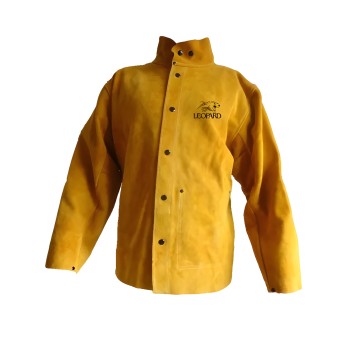
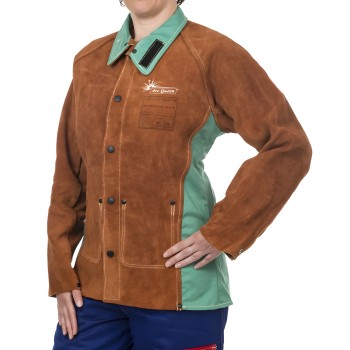
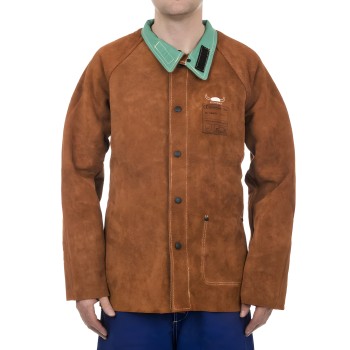
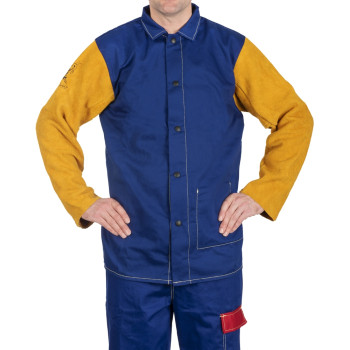
The welder's jacket protects the torso and arms against molten metal spatter, heat, and arc radiation. A key element of welding clothing, it complements the welding helmet and gloves. Discover our selection of welding jackets and clothing.
Why a specific jacket?
Welding exposes the upper body to burning sparks and intense arc radiation. A welding jacket withstands these hazards thanks to flame-resistant fabric or leather, unlike ordinary clothing which would melt or catch fire. Wearing suitable welding clothing is a basic safety requirement.
Leather or flame-resistant textile?
The leather welder's jacket (split leather) offers the best resistance to heat and spatter: it is the choice for intensive MMA and MIG-MAG. Flame-resistant textile jackets are lighter and more flexible, suited to less demanding work or TIG. The choice depends on the process and the intensity of spatter.
Cut and comfort
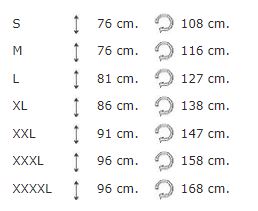
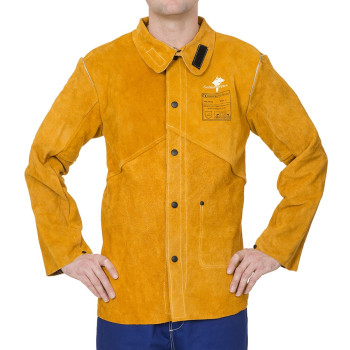
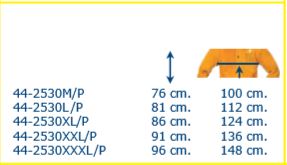
A welder's jacket must offer good freedom of movement: reinforced seams, long sleeves that cover the wrists (complementing gloves), and a closure that does not trap sparks. Comfort matters, especially during long sessions: a jacket that is too heavy or too stiff is tiring and reduces precision of movement.
Other welding clothing
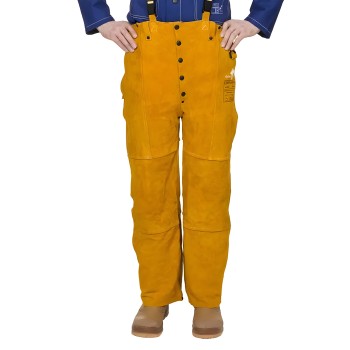
The welding jacket is the centerpiece, but other welder's clothing completes the protection: welder's aprons, sleeves, leg guards, and gaiters protect exposed areas depending on welding positions. The choice of the full ensemble depends on the work: in a workshop, the jacket is often sufficient; in position or in a confined space, more complete equipment is recommended.
Maintenance and lifespan
A good professional welder's jacket lasts a long time if properly maintained: brush off spatter, allow leather to dry naturally, and store the jacket away from moisture. Replace it as soon as the fabric is pierced or the leather is cracked, as a damaged jacket no longer provides adequate protection.
Protection adapted to the process
The choice of welding clothing follows the same logic as gloves: protection is adapted to the process. MMA and MIG-MAG generate more sparks and spatter than TIG; a thick leather welder's jacket is then ideal. For TIG, where spatter is rare, a lightweight flame-resistant textile is sufficient and preserves dexterity. For multi-process welding, choose the protection suited to the most demanding mode.
Investing in durability
A quality professional welder's jacket costs more but lasts longer and provides better protection. Reinforced seams, thick leather, and well-designed closures justify the extra cost compared to an entry-level jacket that will wear out quickly. As with any protective equipment, it is better to invest in reliability than to frequently replace an unsuitable model. Regular maintenance further extends its lifespan.
Standard and certification
A quality welding jacket meets protection standards against heat and flames. Without going into technical details, note that certification attests to tested resistance to molten metal spatter and contact heat. Verify that your welding clothing is certified for welding, and not repurposed from another use that would not guarantee the same protection.
Complementing the helmet and gloves
The welder's jacket complements the welding helmet and gloves to form a coherent ensemble. Protecting the eyes, hands, and torso is the basic trio of welding safety. For positional work, add sleeves, an apron, or leg guards depending on the exposed areas, to cover everything that sparks and radiation can reach.
Finally, if your budget allows, opt for a welder's jacket with discreet ventilation systems that improve comfort in hot workshops, without compromising protection.
Our advice
Choose your welder's jacket according to the process (leather for intensive MMA and MIG, flame-resistant textile for TIG and light work), cut, and comfort. Complete with suitable accessories. Replace it as soon as it is pierced or worn. Browse our selection of welding clothing.
Frequently asked questions
Why wear a welder's jacket?
It protects the torso and arms against molten metal spatter, heat, and arc radiation. Ordinary clothing would melt or catch fire under these conditions. It is a basic safety requirement, complementing the welding helmet and gloves.
Welder's jacket: leather or textile?
The leather jacket (split leather) offers the best resistance to heat and spatter: ideal for intensive MMA and MIG. Flame-resistant textile is lighter and more flexible, suited to less demanding work or TIG.
How to maintain a welding jacket?
Brush off spatter, allow leather to dry naturally, and store the jacket away from moisture. Replace it as soon as the fabric is pierced or the leather is cracked, as it will no longer provide adequate protection.
What other protective clothing for welders?
Welder's aprons, sleeves, leg guards, and gaiters complement the jacket depending on welding positions. The choice of the full ensemble depends on the work: in a workshop the jacket is often sufficient; in position or in a confined space, more complete equipment is recommended.


 Germany
 Netherlands
 Croatia
 Denmark
 Finland
 Greece
 Ireland
 Portugal
 Sweden
 Norway
 Bulgaria
 Estonia
 Latvia
 Lithuania
 Poland
 Czech Republic
 Romania
 Slovakia
 Slovenia
 Hungary
 Spain
Spain



 2-year warranty