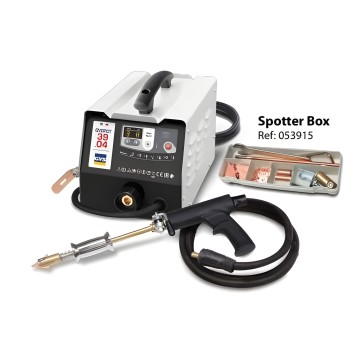
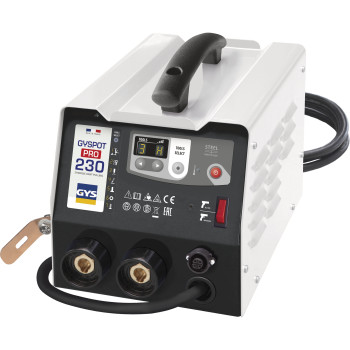
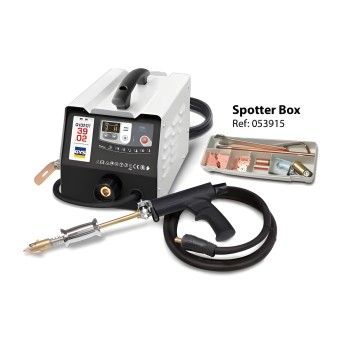
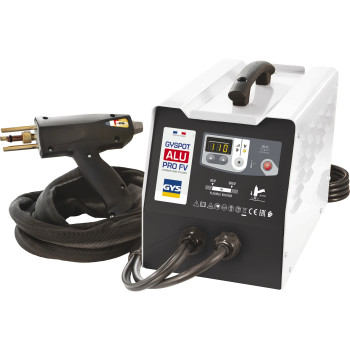
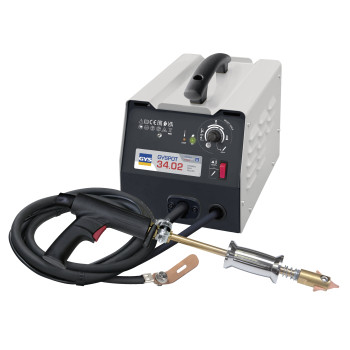
The bodywork stud puller is the tool that allows sheet metal dents to be straightened without removing the panels. Operating by welding temporary anchor points, the stud puller is the ally of both the professional bodywork technician and the occasional repairer. Discover our selection of stud pullers and dent pulling stations.
The principle of the stud puller
The stud puller works in two steps: a nail or washer is welded onto the dent to be straightened (by resistance or arc), then pulled on this anchor point to bring the panel back to its original shape. The welded point is then easily removed. This process preserves the paint on the inside and avoids removing the panels.
Stud puller or paintless dent repair?
The bodywork stud puller handles more pronounced deformations than simple paintless dent repair (PDR). Where PDR pushes the panel from the inside, the stud puller pulls from the outside: it is essential for deep dents or areas inaccessible from the rear. The two techniques are complementary in a bodywork workshop.
Types of stud pullers
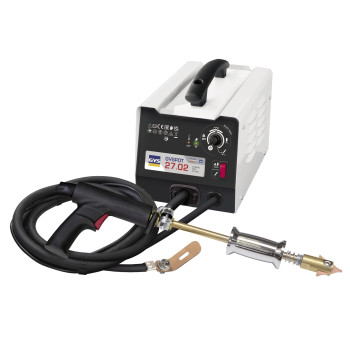
There are several configurations. The 220V bodywork stud puller plugs into a domestic socket and is suitable for workshop use. Portable models sometimes work with a standard MMA machine fitted with an adapter. Others are integrated into dedicated dent pulling stations, with a slide hammer and multiple accessories for handling different dent shapes.
Straightening accessories
The stud puller comes with accessories: nails, washers, a slide hammer, a sliding weight, and a ground clamp. The choice of consumables (shape and size of anchor points) depends on the dent to be treated. A complete set of accessories covers most repair scenarios.
Achieving a successful repair
For a good result, the panel must be clean and prepared at the weld point. Work with successive pulls, assessing progress between each pass. A pull that is too forceful risks deforming the panel in the other direction. Patience and method are the keys to a quality result, complemented by a spot welder for finishing.
The stud puller in a professional workshop
In a professional bodywork workshop, the stud puller is part of the standard toolkit. Professional models offer several anchoring modes (nails, washers, special tips) and various accessories for handling all dent geometries. Combined with a spot welder for structural assemblies, it covers virtually all straightening and repair needs.
A tool accessible to the home user
The 220V bodywork stud puller makes the technique accessible to the home user and small workshop. Plugged into a domestic socket, it allows common dents to be treated without investing in industrial equipment. With a little practice and the right accessories, satisfactory results can be achieved on moderate deformations. It is an economical alternative to routinely visiting a professional bodywork technician for minor repairs.
Stud puller consumables
The stud puller uses nails, corrugated or star washers, and special tips as anchoring consumables. Each shape suits a type of dent: washers cover a wider area, nails concentrate the pull. Having a varied set of consumables makes it possible to handle all configurations of deformation encountered in bodywork repair.
Complementarity with other bodywork tools
The bodywork stud puller is part of a set of tools: the spot welder for structural assemblies, the slide hammer for pulling, and paintless dent repair tools for small dents. By combining these techniques, a bodywork workshop covers virtually all repair cases, from minor impact to partial panel replacement, with professional results on every job. Mastering this complementary set of tools is the hallmark of a complete bodywork workshop capable of handling all types of repair economically and efficiently.
For those wishing to get started, complete stud puller kits with a slide hammer and consumables are available: a good starting point for getting to grips with the technique before investing further in professional equipment.
Our advice
For repairing dents in bodywork, the stud puller is an effective and minimally invasive tool. Choose it based on your power supply (220 V or adaptable), your accessory requirements, and the type of repairs. Complete it with a slide hammer and a good set of nails. Browse our selection of stud pullers and dent pulling stations.
Frequently asked questions
How does a bodywork stud puller work?
A nail or washer is welded onto the dent (by resistance or arc), then pulled on this anchor point to bring the panel back to its original shape. The welded point is then easily removed. This process preserves the paint on the inside.
What is the difference between a stud puller and paintless dent repair?
Paintless dent repair (PDR) pushes the panel from the inside, on small dents that are accessible. The stud puller pulls from the outside, essential for deep dents or those inaccessible from the rear. The two techniques are complementary.
Do you need a special machine for a stud puller?
A 220 V stud puller plugs directly into a domestic socket. Some models work with a standard MMA machine fitted with an adapter. Others are integrated into dedicated dent pulling stations with multiple accessories.
How do you achieve a successful repair with a stud puller?
Clean and prepare the panel, work with successive pulls while assessing progress, without pulling too hard so as not to deform the panel in the other direction. Patience and method are the keys to a quality result.


 Germany
 Netherlands
 Croatia
 Denmark
 Finland
 Greece
 Ireland
 Portugal
 Sweden
 Norway
 Bulgaria
 Estonia
 Latvia
 Lithuania
 Poland
 Czech Republic
 Romania
 Slovakia
 Slovenia
 Hungary
 Spain
Spain



 2-year warranty