Many accessories are necessary to carry out a successful welding operation. Whether professional or beginner, this choice is decisive for the final expected result. The same applies to the gas pressure used, which is a crucial element in welding. It is therefore important to know how to measure and control the flow rate to achieve the objective.
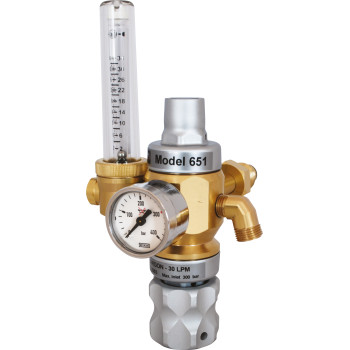
The flowmeter regulator is a device for measuring gas pressure during a welding operation. There are different varieties with diverse characteristics on the market. Discover in this article all the useful information for using and making a good choice of this welding equipment — the flowmeter regulator for refillable welding gas cylinders.
Flowmeter regulator for gas cylinder: what should you know?
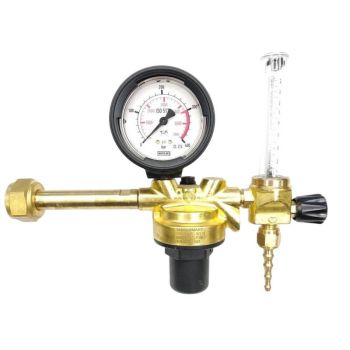
The flowmeter regulator is a measuring instrument used in a welding operation. It allows the pressure of the gas (oxygen, nitrogen, etc.) used to be controlled. It serves to control and quantify the required flow rate of a fluid. This can be liquid or gaseous. The choice of type of this accessory is based on relevant information such as the nature of the gas to be used and the type of work to be carried out. There are for example regulator models equipped with several gauges.
What is the purpose of a regulator on a gas cylinder?
The main role of this equipment is to control gas pressure. This fluid contained in a gas cylinder is at high pressure depending on the temperature. This is not very ideal for its use. It is therefore necessary to master this value in order to adapt it to working conditions.
The regulator intervenes at two main levels in this process. Either:
- To reduce gas pressure: it thus allows any risk of incident that could arise to be controlled and ensures better working conditions;
- To maintain constant gas pressure for specific tasks: a constant gas flow rate is recommended and helps in the success of certain tasks. It intervenes in this case to adjust this value relative to the pressure at the outlet of the gas cylinder.
However, it can be used to check the gas pressure to ensure it is adequate (whether it is too low or not). Too low a pressure is also undesirable for carrying out certain tasks. Beyond these aspects, it must be acknowledged that the flowmeter regulator is a safety device that protects both the worker and their entire working environment from any incident. It thus contributes to good performance.
Which regulator to use and for what type of work?
There are different categories of regulator. They do not all have the same function. The choice must therefore be adapted accordingly. The very first distinction can be made based on the number of pressure gauges on each piece of equipment.
Pressure gauge
This is a device for measuring pressure values. It is used to identify the difference in values within a medium in order to make an estimate. It is most commonly used for monitoring levels in tanks, to determine the level of a liquid or gaseous fluid, etc. The regulator is often equipped with this instrument for greater efficiency and ease of use.
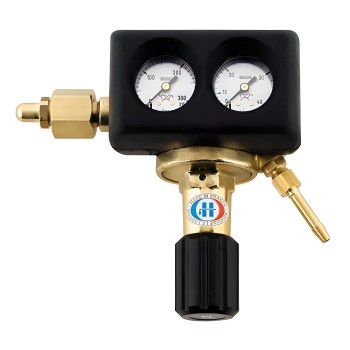
Two-gauge regulator
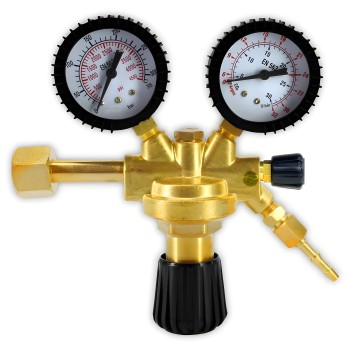
This is a more efficient device suited to many situations. They are generally covered with a rubber layer to protect them against impacts and possible accidents.
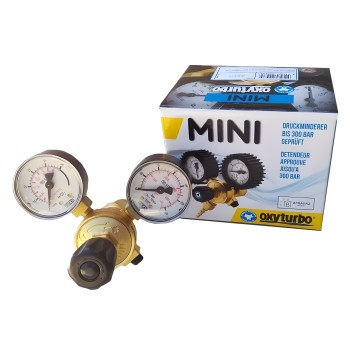
Mini two-gauge regulator for refillable cylinder
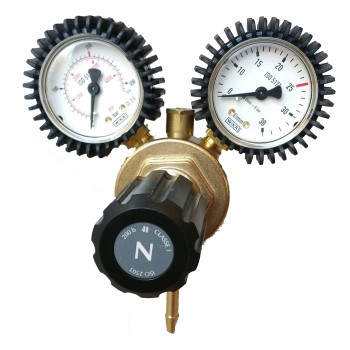
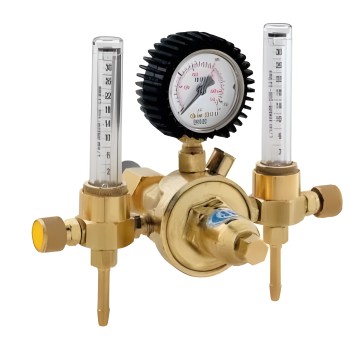
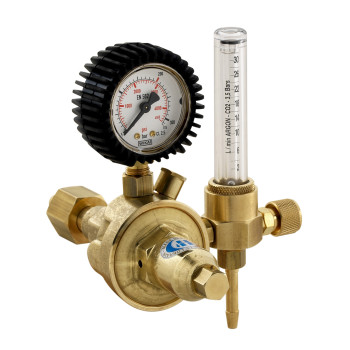
It is used primarily for neutral welding gases. These are generally pure argon or argon + CO² gases. It features pressure gauges with a diameter of Ø 50 mm. The user benefits from an adjustable gas flow rate between 0 and 30 litres per minute.
This model consists of two symmetrically arranged, durable and easy-to-use pressure gauges. The two are connected by a main axle using a washer and a metal thread. This is a flowmeter regulator reserved for neutral welding gases of the pure argon or argon + CO² type. On the metal disc there is a plastic-coated nut with the letter "N" inscribed on the face. This indicates the direction for opening and closing the regulator.
Two-gauge regulator for different gases
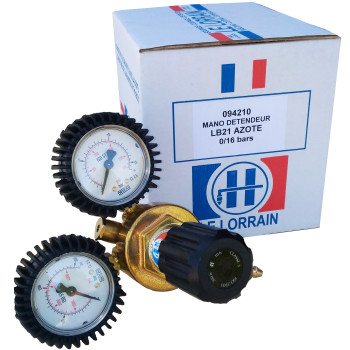
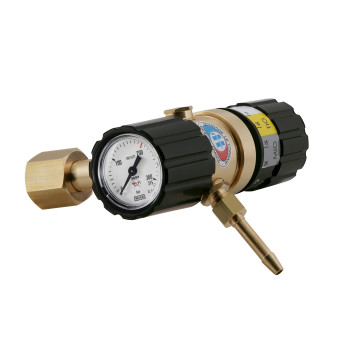
Of course, there are also models designed for nitrogen gas. These feature a pressure gauge with an adjustable low pressure between 0 and 16 bar. There are versions of this equipment suitable for measuring the pressure of acetylene, oxygen, etc.
A somewhat special device, this one allows working on two welding machines simultaneously. Whether TIG or MIG machines, it also ensures the inerting of the pipeline to be assembled. It offers an adjustment range between 0 and 30 litres per minute with a reading dial to ensure precision and control of the gas flow rate used.
The EN 585/ISO 2503 standard
This standard is a reference framework that informs on the conditions and various provisions that welding equipment must comply with. It therefore covers various pieces of equipment including gas regulators and integrated flowmeter regulators for gas cylinders.
Standard conditions
It distinguishes between regulators without an integrated flowmeter — single or dual gauge. Also covered are those connected to gas cylinders using acetylene and compressed gases at close to 300 bar (30 MPa). Liquefied petroleum gases, methylacetylene-propadiene, and carbon dioxide are among those covered by this standard.
This guide explains in detail the appropriate procedure for each model of flowmeter regulator. You will find the principle of TIG, MIG for arc welding, as well as MAG. However, it should be noted that the ISO 2503 standard published in July 2019 includes exceptions. It does not cover regulators with direct connection to a gas cylinder. These are governed by a different regulation.
How to use your regulator correctly?
The use of this welding equipment must not be subject to negligence or certain errors that could lead to serious consequences. Certain parameters must therefore be integrated for proper use. Both beginners and professionals must adhere to these.
The inlet fitting must be tightened properly. It is threaded and can be done by hand. This does not preclude the use of a tightening tool.
The flowmeter regulator must not be greased or clogged with any greasy substance under any circumstances. It may happen that the user tries to smell the gas coming out of this equipment by placing their nose at the connection inlet. This practice is not advisable and must be strictly avoided. If there is a leak at the tightening point for example, a professional should be consulted for further advice, or the equipment should be replaced entirely.
Changing the gas cylinder may leave air in the regulator circuit. The circuit must therefore be purged after a change. There are many other measures to be taken into consideration when handling a flowmeter regulator.
Criteria to consider when choosing your regulator
The success of a welding process also depends on the various pieces of equipment used. A well-considered choice is therefore very important at every stage in order to achieve results that meet expectations.
A precision instrument, the flowmeter regulator comes in different models. It can be classified according to the gas to be used (butane, propane, argon and argon +CO², etc.). This instrument can also differ by model. Indeed, some come with a single or double stage. There are also more complete models featuring a level indicator, a safety system for the user, etc.
The criteria for choosing a regulator are not limited to the model alone. The gas cylinder to be used must also be checked. Its weight enables a good assessment of the fluid constraint. This aspect affects the final result of your welding operation.
Price remains an undeniable criterion in any purchasing process. There are many varieties of flowmeter regulators available on the market. However, you should trust well-known major brands. The assistance provided at the time of purchase and the various information supplied by your seller already constitute a first criterion for evaluating the quality and reliability of the service.
Most certainly, all of this is complemented by the safety provided by your flowmeter regulator. A point that may seem simple, but which deserves attention.
Where to buy your flowmeter regulator for a gas cylinder?
In the digital age, the very first and best option remains online ordering. With just a few clicks, it is possible to access all the necessary information to make a good choice of welding product.
Some websites offer very efficient and fast delivery options to easily ship your equipment to your address. This option saves time and provides access to a wide variety of choices.


 Germany
 Netherlands
 Croatia
 Denmark
 Finland
 Greece
 Ireland
 Portugal
 Sweden
 Norway
 Bulgaria
 Estonia
 Latvia
 Lithuania
 Poland
 Czech Republic
 Romania
 Slovakia
 Slovenia
 Hungary
 Spain
Spain



 2-year warranty