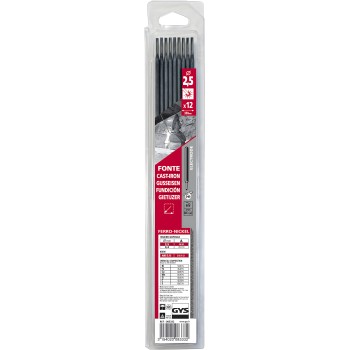
The cast iron welding rod is a specific consumable, essential for repairing this material known to be difficult to weld. Rich in carbon, cast iron cracks easily under heat: only a suitable cast iron rod, generally nickel-based, can achieve a lasting repair. Discover our selection of cast iron welding rods and our tips for successful work.
Why is cast iron difficult to weld?
Cast iron contains a high amount of carbon, which makes it hard but brittle. Under the heat of welding, it undergoes significant thermal stresses that cause cracks, especially upon cooling. Welding cast iron therefore requires a cast iron welding rod capable of absorbing these stresses, and a rigorous temperature management method. This is what distinguishes a successful repair from a failure that cracks a few hours later.
The role of the nickel rod
Most cast iron welding rods have a nickel or ferro-nickel core. Nickel provides great ductility to the bead: it "absorbs" the stresses generated by differences in expansion between the filler metal and the cast iron, limiting cracking. A quality cast iron rod is therefore the primary factor for success when repairing this demanding material.
Arc welding cast iron
The cast iron rod is most often used with a MMA welding machine with coated electrodes. The method is based on a few principles: perfectly clean the workpiece, weld with short and spaced beads, lightly peen each bead while still hot to release stresses, and allow cooling very slowly. Rushing is the enemy of cast iron.
Hot or cold?
Two approaches exist. The "hot" method involves preheating the workpiece (400 to 600 °C) before welding, then allowing it to cool very slowly: it significantly reduces the risk of cracking, but requires equipment and time. The "cold" method welds without preheating, using a nickel cast iron welding rod and very short beads: faster and practicable on site, it remains delicate. The choice depends on the size and importance of the part.
Peening, an essential step
Whatever the process, lightly peening each bead while still hot is a key action. It slightly stretches the deposited metal and releases internal stresses that would otherwise cause cracks upon cooling. Combined with short beads and slow cooling (under an insulating blanket or in sand), it maximises the chances of success.
Choosing the right diameter
Like any electrode, the cast iron welding rod is chosen according to the thickness of the workpiece and the machine's amperage. For common repairs, a medium diameter is suitable. Keep your rods dry: moisture degrades the coating and affects weld quality. A quality electrode holder ensures a solid contact.
Beyond the arc
While the nickel cast iron rod and MMA process are the most common approach, cast iron can also be repaired by TIG for greater control, or by semi-automatic welding with a special nickel wire for larger repairs. In all cases, temperature management remains the determining factor.
Preparing the cast iron workpiece
The success of a cast iron weld starts with careful preparation. Cast iron, often old and saturated with grease or oil, must be perfectly cleaned and degreased at the weld area, otherwise porosity will occur. On a crack, it is recommended to grind a V-groove to allow good penetration of the cast iron rod, and to drill the ends of the crack ("crack arrest") to prevent its propagation. Locally preheating the area reduces thermal shock. This preparation, too often neglected, makes all the difference between a repair that holds and one that reopens upon cooling. Patience is, once again, the welder's best ally.
Our advice
To achieve a successful cast iron weld, the essentials lie in the choice of rod (nickel-based) and the method: clean workpiece, short beads, peening, slow cooling. Preheating improves results on thick or critical parts. Arm yourself with patience and the right cast iron welding rod, and your repairs will stand the test of time. Browse our selection of rods for cast iron welding.
Frequently asked questions
Which rod to use for welding cast iron?
A specific rod with a nickel or ferro-nickel core. Nickel provides great ductility to the weld bead, allowing it to absorb expansion stresses and limit cracking, the main pitfall of cast iron welding.
Why use a nickel rod for cast iron?
Because nickel makes the bead very ductile: it "absorbs" the stresses generated by differences in expansion between the filler and the cast iron, which is rich in carbon and brittle. This is what prevents the bead from cracking upon cooling.
Should cast iron be preheated before welding?
It is not mandatory, but it noticeably improves results on thick or critical parts. The "hot" method preheats the workpiece (400 to 600 °C) and then allows it to cool slowly, reducing the risk of cracking. The "cold" method welds without preheating, using very short beads.
How to avoid cracks when welding cast iron?
By welding with short and spaced beads, lightly peening each bead while still hot to release stresses, and allowing cooling very slowly (under an insulating blanket or in sand). The workpiece must also be perfectly clean and, for cracks, chamfered.
What is the best rod for welding cast iron?
To weld cast iron, use a suitable nickel or ferro-nickel electrode. Work with a clean preparation, moderate current and slow cooling to limit cracking.
Which rod should be used to weld cast iron?
To weld cast iron, use a suitable nickel or ferro-nickel electrode. Work with a clean preparation, moderate current and slow cooling to limit cracking.


 Germany
 Netherlands
 Croatia
 Denmark
 Finland
 Greece
 Ireland
 Portugal
 Sweden
 Norway
 Bulgaria
 Estonia
 Latvia
 Lithuania
 Poland
 Czech Republic
 Romania
 Slovakia
 Slovenia
 Hungary
 Spain
Spain



 2-year warranty